Little Lost Nun by Melinda Johnson

Little wooden nun by author and artist Annalisa Boyd, available at @ParkEndBooks.com as a set.

Nuns, both little and life-sized are featured in this book about two friends who overcome sadness and experience the resurrecting power of love.

My oldest making Sister Mary and Nun Anna as part of the #summerofthelittlelostnun activity.

I was honored to be asked to write an author’s review (and read the manuscript) of Little Lost Nun by Melinda Johnson before it was sent to the printer. My daughters and I had been talking about the book because we saw Melinda’s post about her sweet paper nun exploring nature and having adventures of her own. My daughters took to this hands on experience by making nuns of their own. Their nuns went on walks with them, smelled flowers in our garden, stood with us at prayer time, and my oldest even kept hers under her pillow to talk to at night.

Nun Anna stops to pick a flower.
Sister Mary slides with a friend.

This adventure with nuns was also an excellent opportunity to talk to my kids about Orthodox monasticism. Where we live we are a long trip away from a monastery and my kids haven’t experienced a visit to a monastery garden, as is described in this book. After we received our print copy my oldest daughter and I read a chapter each night before bed, learning with the two main characters, Nina and Tabitha how grace can cover a multitude of hurts. Nina and her mother visit the monastery for a women’s weekend retreat, Tabitha’s mom joins them on a whim and displays a flighty parenthood throughout the book.

Sister Mary and Nun Anna go to church.

I don’t want to give too much away about the plot or conclusion, but there is a thread of redemption, hope, and love throughout the story. Each girl has a contrasting family life and yet both are loved the same by Gerontissa (the monastery Abbess). This book is an excellent read along with your children or one for 8-12 year olds to read on their own. Make sure they have a little nun (wooden, paper, or fabric) to take them with on their adventures.

Little Lost Nun may be purchased directly from @ParkEndBooks.com here (with a nun): https://parkendbooks.com/shop/little-lost-nun-and-peg-doll-set/

Nun Anna eats a snack.

This Lent, Park End Books is doing a special “Lent with Little Lost Nun,” each Sunday my girls and I will sing, pray, and adventure with our nuns. Please join us!

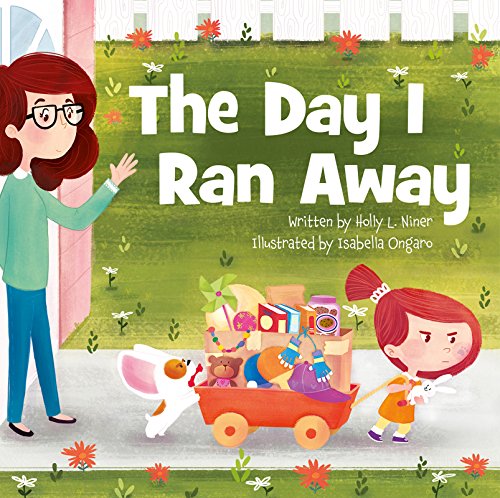
The Day I Ran Away, by Holly L. Niner

“While Dad tucks her in, a little girl named Grace calmly recounts her day—which was anything but calm. She had a tantrum (because of some injustices involving a purple shirt and breakfast cereal) and was banished to her bedroom before deciding to run away. Understanding that kids have ups and downs, Grace’s mom wisely gave her daughter the space and time she needed to reach her own decision to return home—to open arms.

The Day I Ran Away amusingly captures Grace’s mutable moods and childlike logic. Warm, humorous digital paintings offer fun details to keep little listeners busy. Kids can compare the bedtime and daytime scenes and try to figure out how Grace got that purple paw-print on her cheek—and when it got washed away. They can mimic Grace’s facial expressions or copy her poses for some soothing bedtime yoga. And of course, they can create a safe place to run away to when the injustices of Pre-K existence become too much to bear. A pop-up tent in the yard and the haven beneath the dining room table are excellent run-away destinations, as long as you come home for dinner.”

The Day I Ran Away from Flashlight Press is like a well-choreographed dance. Three characters, two voices, three points of view, two timelines, two picture sequences, and a dog spin around each other with no missed beats. The threads fall together easily, and despite action and humor in Isabella Ongaro’s illustrations, the tone of the book is peaceful. The little girl’s growing drowsiness in the bedtime pictures makes sense. She’s been on a big adventure that never took her beyond the reach of love and safety. You’ll want to read The Day I Ran Away over again, even if you aren’t a preschooler, because there’s more to ponder each time you page through the story.

Time

Children at the picture-book stage have a tenuous grasp of time. Their abstract thought wires aren’t fully installed, so they understand time in terms of events. How many times will I go to bed and wake up before that happens? Will it be at breakfast time? Dinner time? Will it take as long as driving to Aunt Sally’s house? 

The Day I Ran Away plays with a preschooler’s time sense by running two chronologies simultaneously. The present bedtime conversation unfolds with words and pictures on the left page of each spread, and the past action from earlier in the day appears in pictures on the right. Without confusion, it puts the reader squarely into a multi-dimensional experience of time. But it’s done so naturally that little ones won’t notice that it’s happening.

Beginning at the End

The trustful connection between the little girl and her father is apparent from the first words of their conversation, but notice the illustration on the title page. It shows the little girl eating dinner with her mother, a meal that must have happened just before bedtime.  The title and cover tell us the little girl ran away, but we begin the story knowing she’s home safe now, and at peace with both parents. Like the cozy bedtime ritual, this early scene-setting creates a safe place from which to reflect on the emotions and reactions that created the chain of events. [As a parent, it’s interesting to see how the father’s calm acceptance of the story includes helping the little girl realize that her mother’s reactions were responses to her daughter’s choices.]

Beginning with the end is also an impressively subtle way of centering a little reader in the action but keeping the parents as the story’s frame. Preschoolers are the center of their own world, but parents are the first orbital ring. The book is structured the way a child’s world is structured – her all-absorbing consciousness of herself is lived inside parental creativity and guidance. This is her adventure, but it won’t have its full meaning for her until she’s told her father all about it before she falls asleep.

The Parents

The parents’ relationship is a strong message in the book, although they don’t appear together in a picture until the last page. Inside the father’s comments and questions to the little girl, you can hear his respect for the mother and his support of how she’s parenting their child. This is at least as powerful as his low-key, almost Socratic method of processing the day with his daughter.

For her part, the mother is letting this bedtime meeting happen without her input. She’s trusting the father and daughter to each other at the end of a long day, but the tone of the book tells you it’s not just because she’s tired. These two are parenting as a team, and their interactions with their daughter are thoughtfully chosen.

The Dog

In addition to his helpful contributions to the bedtime yoga routine, the dog is a wonderful buddy for his little friend. He mirrors or responds to her emotions in every picture. It’s adorable, but it’s also another talking point in the book. The dog’s facial expressions, posture, and actions are clues to the human emotions in each scene, while offering a friendly, four-legged suggestion of how to be there for someone you love, no matter what.

And Finally….

The Day I Ran Away is a proper picture book. It’s well-made, with a hard cover and thick, glossy pages. The colors are bright and attractive, the illustrations are full of life, and there are plenty of interesting details to point out and chat about as you practice paying attention and reading for meaning. The book is standard size, large enough to hold up and read to a circle of children, and just right for reading in the best sofa corner with at least two children on your lap.

The Day I Ran Away is available on Amazon in hardcover and Kindle editions. You can find Activity Guides to use along with the book here.

I received a copy of this book from Flashlight Press in exchange for this review.

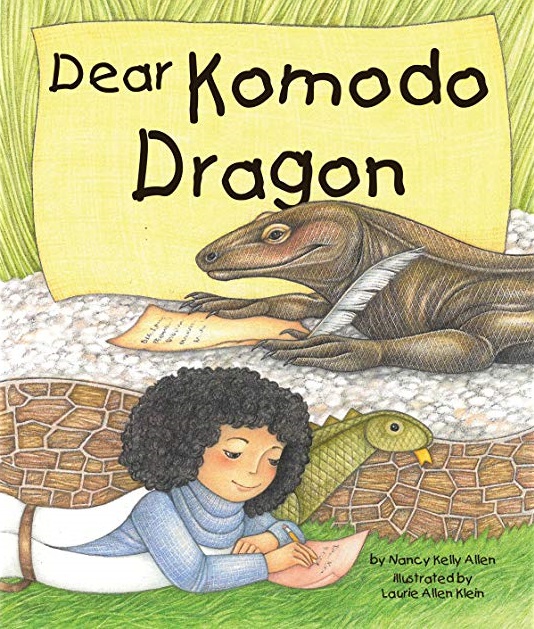
Dear Komodo Dragon, by Nancy Kelly Allen

Lots of children have pen pals but one little girl has a real-life dragon—a Komodo dragon—for a pen pal! Leslie plans to be a dragon hunter when she grows up. When she and Komodo become pen pals, the wise-cracking dragon adds a generous helping of humor to letters that are chock full of accurate, interesting facts. Leslie learns not only about the world’s largest lizard, but also about the dangers they face. As their friendship builds, will Leslie change the way she thinks about dragons?

Do you remember that teacher we had in elementary school who was always trying to make learning fun? Yes, you remember. I thought you would. Sometimes, the fun was actually fun. Sometimes, not so much. Personally, I’d rather just plow through the math without also wishing I felt as entertained as that hopeful teacher hoped I would.

That’s why Dear Komodo Dragon surprised me! It’s definitely an educational book. You’ll find zoology, conservation, and math in its pages, and you could spin a lesson about letter-writing out of it, too. Arbordale provides substantial curricular support for their books. There’s a 30-page Teaching Activity Guide for Dear Komodo Dragon, perfect for classroom or homeschool use, and the book itself includes a 4-page For Creative Minds section as well.

But it’s still a story! Leslie and Komo, her dragon pen pal, both have relatable personalities, and their exchange is light-hearted and interesting (despite being informative!). You’ll realize how much you’ve been drawn into the story when you come to the plot twist just before the end! (No spoilers here!)

Laurie Allen Klein’s illustrations, like the text, are realistic but still imaginative, and provide depth to the characterizations and supporting detail for the information in the text. I especially appreciated the added dimension she provided in, for example, the labeled drawings of  various kinds of dragons displayed on pages 6-7. It’s evidence that every opportunity, every space and moment in the book, was used to add value for the reader.

I think my grade-school self would have welcomed this book with relief and interest. Dear Komodo Dragon is both fiction and nonfiction, a science story that deserves to be called both “science” and “story.” Bright pictures, clean text, engaging characters, and that plot twist I mentioned above all come together to make a good day in the classroom, or in your favorite reading nook at home.

Dear Komodo Dragon and its teaching resources are available directly from Arbordale Publishing, and also on Amazon in paperback, hard cover, and Kindle editions.

I was granted access by the publisher to a digital edition of this book in exchange for this review.

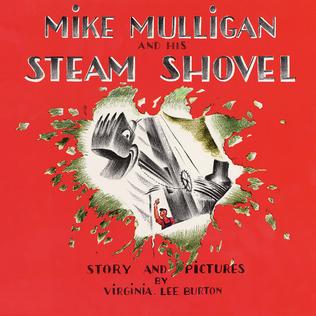
Mike Mulligan and His Steam Shovel, by Virginia Lee Burton

I can’t remember my life before Mike Mulligan and His Steam Shovel. My mama read it to us, sitting on the big bed in her room. The bedspread was lemon yellow, with hundreds of tiny pom-poms all over it. I’m sure there’s a word for this kind of fabric, but I didn’t know the word. I just really liked twiddling with those little green-pea-sized poms.

I love this book so much. I love that it was published before picture books became standardized (1000 words, 32 pages, always no matter what). I love the glimpse of old-fashioned small-town life it provides, and the way it alludes to industrialization and technology and their impact in one human microcosm. I love the way you can read the whole story as a testament to the wonders of reusing and recycling. I love the rhythm of the words, the way they stick in your memory and appeal to the part of your brain that descended from your pre-literate ancestors who told stories in sing-song voices around a crackling fire in the cave.

It wasn’t till I read Mike Mulligan and His Steam Shovel to my own child that I noticed the footnote near the end of the book. It’s on the page where “the little boy, who had been keeping very quiet, had another good idea.” (I’m not going to spoil the story for you. You’ll have to read the book to find out what the idea was and why Mike Mulligan needed it.) The footnote says, “*Acknowledgements to Dickie Birkenbush.”

Who is Dickie Birkenbush?

A few seconds of research provides the answer. Dickie Birkenbush was the 12-year-old son of Virginia Lee Burton’s friends. His family happened to be at the Burton house for dinner one night when Virginia was talking about the book. She had “written herself into a corner” and wondered what to do. Dickie offered a suggestion, she took it, and the rest is picture-book history. Interestingly, Dickie’s name was spelled incorrectly in the original edition of the book (which I have). In later editions, the footnote is corrected to read “*Acknowledgments to Dickie Berkenbush.”

You will be pleased to learn that Dickie grew up to be a fire chief, police chief (it was a small town), and selectman. I’m sure he did a much better job than Henry B. Swap.

Mike Mulligan and His Steam Shovel is available on Amazon in library binding, paperback, board book, ebook, audiobook, and hardcover 75th anniversary editions.