
Meh: A Story about Depression is a wordless picture book with remarkably evocative, content-rich illustrations leading the reader on an emotional and spiritual journey through an episode of depression and recovery.
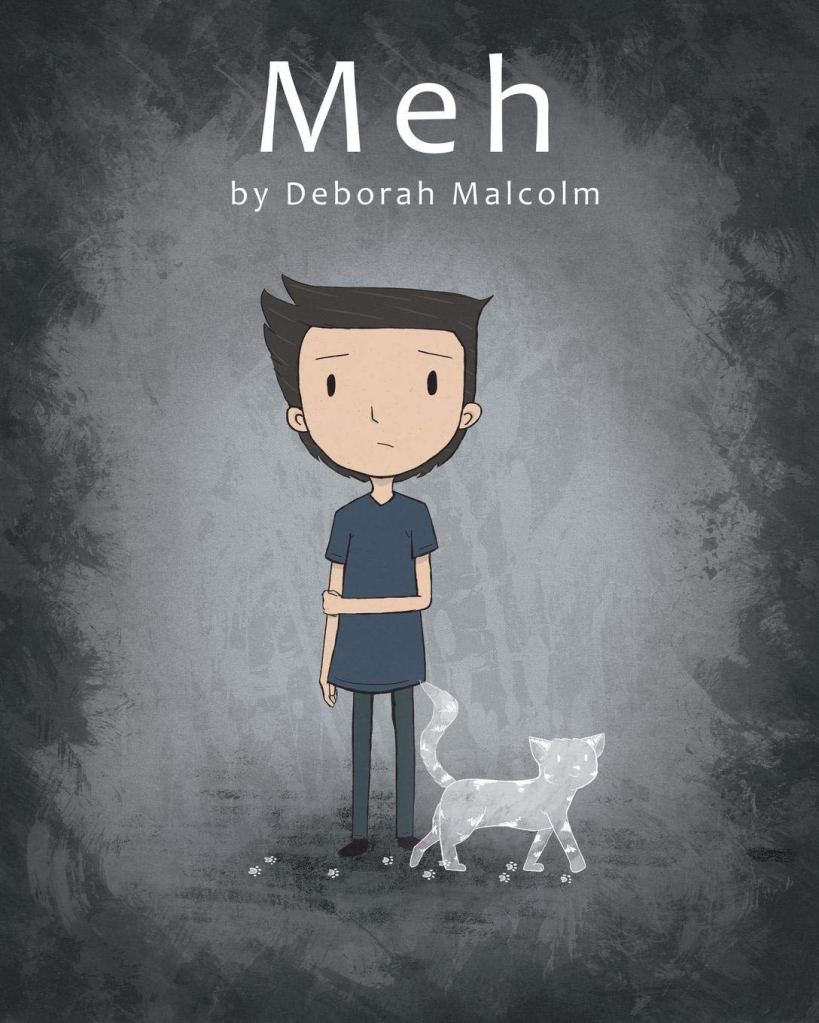
The concept of using a picture book to launch a conversation about depression with a child is fascinating and brilliant, in my view. You’ll want to see the book for yourself, through your own lens, and no doubt it will bring to mind memories of experiences and observations. It’s also a testament to the miraculous quality of art – I read all of the following from a book that has no words!
The Title
The title is a word made popular by the “meh” emoji (star of the recent Emoji Movie), and it’s a fascinating choice for two reasons. Emojis are a regular part of life for children and teens, and it’s telling that this emoticon was chosen as the main character in the film. Like the film, this picture book’s choice of “meh” is an important nod at research linking technology use with anxiety, and depression, especially in younger users. It’s one of many aspects of the book that lead easily into a conversation that’s essential for a child encountering depression, or anxiety.
But the title is also an immediate, powerful statement of understanding. “Meh” means “I’m not strongly negative or positive.” It suggests an absence of feeling where feeling would be desirable, so there’s an overtone of wishfulness. This is a simple, one-word verbalization of the complex numbness that’s often a hallmark of depression. And the choice to describe this feeling with a word anyone under 30 will immediately associate with an emoji is a message to a child reader that whoever wrote this book “gets it” and is familiar with the world the child is confronting. Loneliness is depression’s weapon, and to be understood is the first, best antidote.
No Text
One difficult but important task in caring for a child suffering from depression or anxiety is to leave space for them to vocalize what’s happening. It’s so tempting, in our effort to show understanding and support, to rush in with our own words, covering over their experience with our perception of it. The wordless pictures in Meh remind us to ask and then be quiet, letting the words come from the child. The book includes a list of questions to encourage discussion, along with a kindly reminder to be clear that there are no wrong answers.
In addition to the questions provided, Meh lends itself to the kind of simple, non-threatening questions you would ask about any picture book you’d read with a child. But in this case, those natural questions lead straight into important conversation because the illustrations are creative and intelligent. These questions could include the following, and more:
- Why is there so much blackness in the picture now?
- When did you first notice the cat?
- Why do you think the cat is light-colored?
- How do you think the boy feels about the cat?
- How do you think the cat feels about the boy?
- Does the cat remind you of any people you know? Why?
- What decision do you think the boy is making on this page where he’s looking up at the cat?
Two Roles
That last question highlights another vital strong point of the book. In the depths of those black pages (and moments), our first reading of the picture is that the loving little cat is leading this boy out of the darkness (sorry for the spoiler!). The cat is rescuing the boy. This is true, but it is not the whole truth, either in the picture or in life. The boy is choosing to follow the cat.
One illustration is especially poignant. On the left page, we see the boy standing at the bottom of a formidable rocky hill, looking up at the cat, who is looking down at him from the top. On the facing page, the boy is struggling hard to climb over the ledge onto the top of the hill, where the cat is waiting for him. Just below that image, we see the boy and the cat resting together. The message is clear – the cat is not rescuing the boy single-handedly. The boy is rescuing himself, with merciful and responsible guidance from the cat.
This is an enormous truth. All of us in the darkness need that leading light, AND we need the gritty, hang-on-by-your-fingernails effort to work our way back to healthy life.
#BetheCat
Meh is an excellent tool for reaching children struggling with depression or anxiety. But it can also inspire informed sympathy in children who may see a classmate or cousin who needs help. You can read the book through the eyes of either character (or both!). Children will notice that the cat enters gently – at first, we see only the tiny paw prints on the dark earth – but becomes powerful as a lion when strength is needed. The cat is encouraging, but not enabling. And the cat stays with the boy through the entire journey, even the end of the journey, in peace and celebration. I would love to see the #bethecat hashtag taken over by children and caregivers who are choosing to walk into the darkness, and out again, for the people they love.
A paperback edition of Meh: A Story about Depression is available on Amazon.
I received an electronic copy of this book from the publisher in exchange for an honest review.

 More to the Story