Guest Post: A House of Books

Guest poster Melissa Naasko invites us to a family ritual and the powerful reason she reads to her children. 

In a corner of my house is a round oak table that was the kitchen table my husband sat at as a child. It is where the teenaged children do their school work. Next to it is a set of bookshelves that house their books and my husband’s; these are the books that are expensive or fragile and ready for when they are needed, and the little children are not allowed to play with these books or really even look at them too hard.

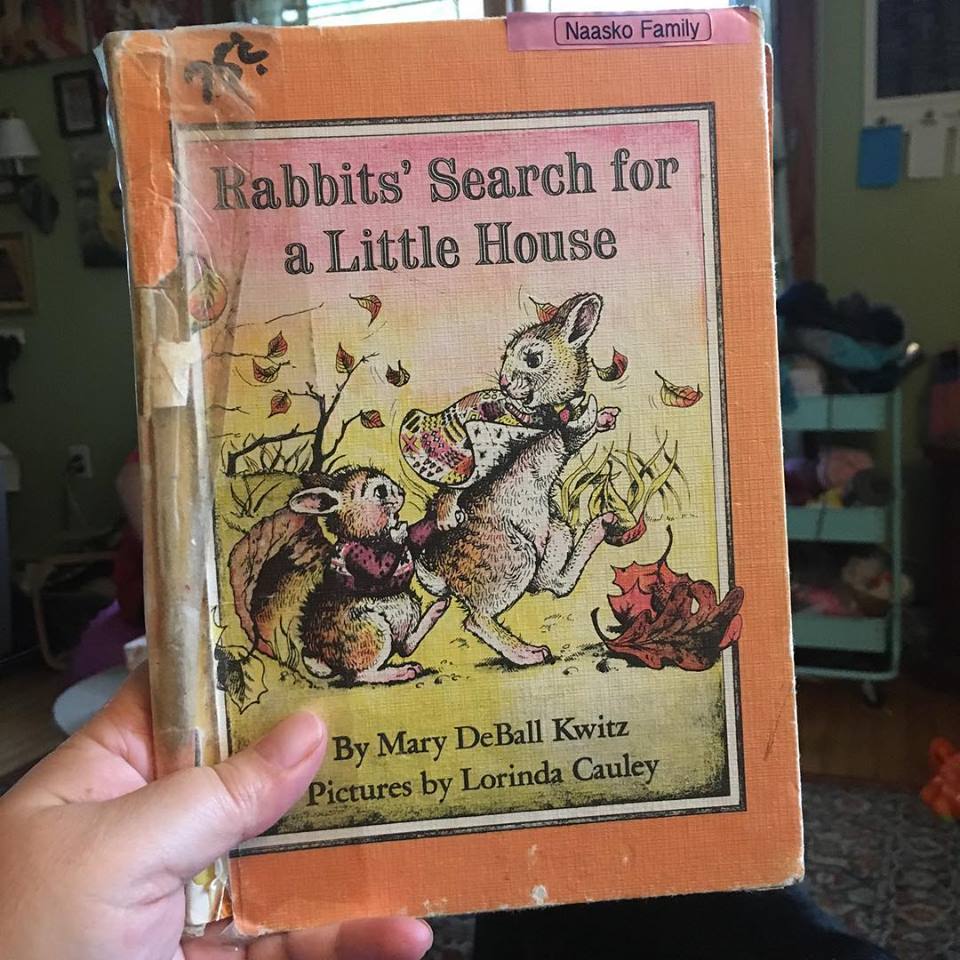
On the shelf with the Theology books sits an incredibly battered book, its cardboard cover fraying badly at the corners and its binding taped back together in many places and only occasionally with any real skill. It’s a cheap book club edition of a children’s book with minimal investment in its printing costs, which explains the oddly orange hue to every page. It is worn and damaged and looks ready for the bin, but it is a prized book among my children. It is carefully placed on a high shelf near the canon law book and those of the history of the Russian Church. It is there precisely because it is fragile and valuable and ready for when it is needed.

The Calm

I have heaps of children, just heaps of them. There are eleven of them all in all, six girls and five boys. You learn a lot of things by having more children than you can count on both hands, and one of those is a sense of purpose in calm. I am not the kind of mother who seeks to make every moment of childhood this memorable, Pinterest-driven event “for the ‘gram’” because no one has that much emotional currency for that many kids. I think no one has that for any number of kids; it would be exhausting. I am not the woman who turns every event into a holiday. I am not a curmudgeon about things, but I do quietly sip tea as other mothers panic about their leprechaun and April fools brunches and think, “Uh, no.” Just no.

That said, there is one notable exception, and that is the first snow. Many years ago, now more than twenty, my oldest child came into the world on the first snow. It was the middle of September, because Colorado. I woke up one cold morning to find that while I slept my water had broken and with it came a rush of knowledge that nothing would ever be the same again. It was the beginning of a complicated and messy and beautiful story that is still unfolding to this day.

The Snow

While he was still tiny, while perusing and sifting through the books at a thrift store, I found one about a first snow. There is something about that first snow that begs us to hunker down and wall ourselves off from the outside. We want to be drenched in cocoa and thick socks and fluffy blankets. Thinking about how my first-born drove my insatiable need for domesticity, it seemed a perfect element that he was born on the first snow. It all comes together. I bought the book for a quarter. I only know it was a quarter because the price is still on it, and I cannot remember anything else I may or may not have bought that day because only this is lasting.

The Ritual

In this book, a mother rabbit and her wee little rabbit are looking for a winter home because the approaching winter is slowly taking their summer one – the leaves are falling off the bush that sheltered them. They look and look, but every inn is full and they are turned away at every knock, and so ultimately they have to make their own home. I won’t deprive you of the joy of reading this charming little book to learn how this happens, and I fully expect you to find it and read it. Let it suffice to say that when the snow finally comes, they can view it from inside their own cozy little home.

Since the very first time I read this book, I felt like the mother rabbit and her wee little rabbit and made their home in my heart. The very next first snow, I read this little book to my oldest child and I made tea and even cake. It has continued this way every first snow since. The ritual is not elaborate. We make something to eat and drink, and what we have changes and who does the baking does as well. There are years when one or another child has claimed this privilege. The only added complexities were the increasing number of children who sat around the table and listened to the book as they sipped tea or cocoa and snuggled down into their blankets.

The Reason

Now come the years when fewer children sit around the table than the year before. There are children who are grown and away at college or work and are not there to listen to the story. The ebb and flow of the conversation have changed because there are no more babies to quiet and no toddlers to wrangle. Someday we will come to the first snow when the youngest one of these children is too old to sit and listen to her mother read the book. Perhaps I will read it to myself? While a part of me grieves for this moment, this slow approaching shift in the plot line of my life, I know that the house I have built is sturdy and strong, and what is more is that they will know it, too.

The book is called Rabbit’s Search for a Little House, and it was published way back in 1988. It was written by Mary DeBall Kwitz and illustrated by Lorinda Cauley. I bought a copy for my oldest son’s twenty-first birthday to remind him of the stories of the day that he was born, when fallen branches had knocked out the power to the doctor’s office and the streetlights were out. I want him to remember the safe harbor that is my love and the love of his father and siblings and the home he can always return to when it becomes cold outside. This is why we read to children. We read to them to give them a place to come back to, one that can outlast us, one that they can then give to their children. We read to build a wee little, warm little, snug little house for ourselves and our little rabbits.

Melissa_Naasko_280

Melissa Naasko is the wife of an Orthodox deacon, the mother of eleven hungry children, and author of Fasting as a Family from Ancient Faith Publishing. She cooks, knits, and writes from the Upper Peninsula.

The Day I Ran Away, by Holly L. Niner

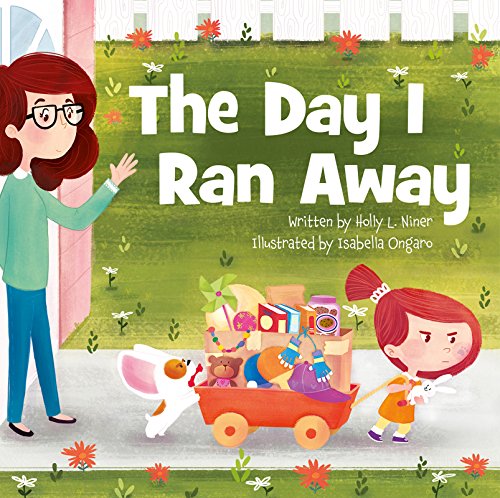
“While Dad tucks her in, a little girl named Grace calmly recounts her day—which was anything but calm. She had a tantrum (because of some injustices involving a purple shirt and breakfast cereal) and was banished to her bedroom before deciding to run away. Understanding that kids have ups and downs, Grace’s mom wisely gave her daughter the space and time she needed to reach her own decision to return home—to open arms.

The Day I Ran Away amusingly captures Grace’s mutable moods and childlike logic. Warm, humorous digital paintings offer fun details to keep little listeners busy. Kids can compare the bedtime and daytime scenes and try to figure out how Grace got that purple paw-print on her cheek—and when it got washed away. They can mimic Grace’s facial expressions or copy her poses for some soothing bedtime yoga. And of course, they can create a safe place to run away to when the injustices of Pre-K existence become too much to bear. A pop-up tent in the yard and the haven beneath the dining room table are excellent run-away destinations, as long as you come home for dinner.”

The Day I Ran Away from Flashlight Press is like a well-choreographed dance. Three characters, two voices, three points of view, two timelines, two picture sequences, and a dog spin around each other with no missed beats. The threads fall together easily, and despite action and humor in Isabella Ongaro’s illustrations, the tone of the book is peaceful. The little girl’s growing drowsiness in the bedtime pictures makes sense. She’s been on a big adventure that never took her beyond the reach of love and safety. You’ll want to read The Day I Ran Away over again, even if you aren’t a preschooler, because there’s more to ponder each time you page through the story.

Time

Children at the picture-book stage have a tenuous grasp of time. Their abstract thought wires aren’t fully installed, so they understand time in terms of events. How many times will I go to bed and wake up before that happens? Will it be at breakfast time? Dinner time? Will it take as long as driving to Aunt Sally’s house? 

The Day I Ran Away plays with a preschooler’s time sense by running two chronologies simultaneously. The present bedtime conversation unfolds with words and pictures on the left page of each spread, and the past action from earlier in the day appears in pictures on the right. Without confusion, it puts the reader squarely into a multi-dimensional experience of time. But it’s done so naturally that little ones won’t notice that it’s happening.

Beginning at the End

The trustful connection between the little girl and her father is apparent from the first words of their conversation, but notice the illustration on the title page. It shows the little girl eating dinner with her mother, a meal that must have happened just before bedtime.  The title and cover tell us the little girl ran away, but we begin the story knowing she’s home safe now, and at peace with both parents. Like the cozy bedtime ritual, this early scene-setting creates a safe place from which to reflect on the emotions and reactions that created the chain of events. [As a parent, it’s interesting to see how the father’s calm acceptance of the story includes helping the little girl realize that her mother’s reactions were responses to her daughter’s choices.]

Beginning with the end is also an impressively subtle way of centering a little reader in the action but keeping the parents as the story’s frame. Preschoolers are the center of their own world, but parents are the first orbital ring. The book is structured the way a child’s world is structured – her all-absorbing consciousness of herself is lived inside parental creativity and guidance. This is her adventure, but it won’t have its full meaning for her until she’s told her father all about it before she falls asleep.

The Parents

The parents’ relationship is a strong message in the book, although they don’t appear together in a picture until the last page. Inside the father’s comments and questions to the little girl, you can hear his respect for the mother and his support of how she’s parenting their child. This is at least as powerful as his low-key, almost Socratic method of processing the day with his daughter.

For her part, the mother is letting this bedtime meeting happen without her input. She’s trusting the father and daughter to each other at the end of a long day, but the tone of the book tells you it’s not just because she’s tired. These two are parenting as a team, and their interactions with their daughter are thoughtfully chosen.

The Dog

In addition to his helpful contributions to the bedtime yoga routine, the dog is a wonderful buddy for his little friend. He mirrors or responds to her emotions in every picture. It’s adorable, but it’s also another talking point in the book. The dog’s facial expressions, posture, and actions are clues to the human emotions in each scene, while offering a friendly, four-legged suggestion of how to be there for someone you love, no matter what.

And Finally….

The Day I Ran Away is a proper picture book. It’s well-made, with a hard cover and thick, glossy pages. The colors are bright and attractive, the illustrations are full of life, and there are plenty of interesting details to point out and chat about as you practice paying attention and reading for meaning. The book is standard size, large enough to hold up and read to a circle of children, and just right for reading in the best sofa corner with at least two children on your lap.

The Day I Ran Away is available on Amazon in hardcover and Kindle editions. You can find Activity Guides to use along with the book here.

I received a copy of this book from Flashlight Press in exchange for this review.

Dear Komodo Dragon, by Nancy Kelly Allen

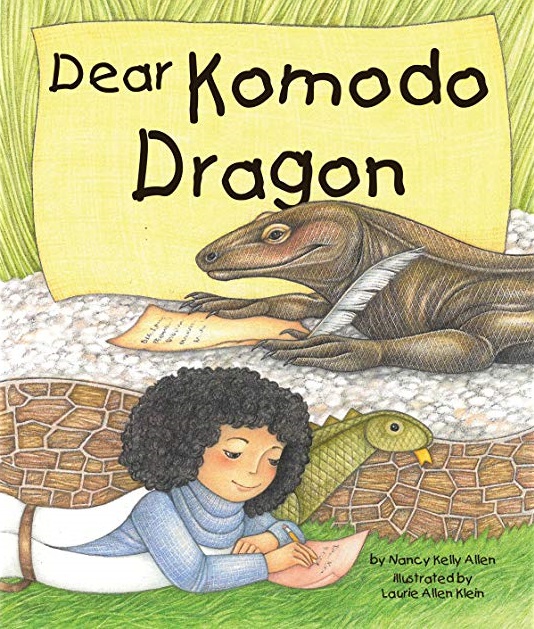
Lots of children have pen pals but one little girl has a real-life dragon—a Komodo dragon—for a pen pal! Leslie plans to be a dragon hunter when she grows up. When she and Komodo become pen pals, the wise-cracking dragon adds a generous helping of humor to letters that are chock full of accurate, interesting facts. Leslie learns not only about the world’s largest lizard, but also about the dangers they face. As their friendship builds, will Leslie change the way she thinks about dragons?

Do you remember that teacher we had in elementary school who was always trying to make learning fun? Yes, you remember. I thought you would. Sometimes, the fun was actually fun. Sometimes, not so much. Personally, I’d rather just plow through the math without also wishing I felt as entertained as that hopeful teacher hoped I would.

That’s why Dear Komodo Dragon surprised me! It’s definitely an educational book. You’ll find zoology, conservation, and math in its pages, and you could spin a lesson about letter-writing out of it, too. Arbordale provides substantial curricular support for their books. There’s a 30-page Teaching Activity Guide for Dear Komodo Dragon, perfect for classroom or homeschool use, and the book itself includes a 4-page For Creative Minds section as well.

But it’s still a story! Leslie and Komo, her dragon pen pal, both have relatable personalities, and their exchange is light-hearted and interesting (despite being informative!). You’ll realize how much you’ve been drawn into the story when you come to the plot twist just before the end! (No spoilers here!)

Laurie Allen Klein’s illustrations, like the text, are realistic but still imaginative, and provide depth to the characterizations and supporting detail for the information in the text. I especially appreciated the added dimension she provided in, for example, the labeled drawings of  various kinds of dragons displayed on pages 6-7. It’s evidence that every opportunity, every space and moment in the book, was used to add value for the reader.

I think my grade-school self would have welcomed this book with relief and interest. Dear Komodo Dragon is both fiction and nonfiction, a science story that deserves to be called both “science” and “story.” Bright pictures, clean text, engaging characters, and that plot twist I mentioned above all come together to make a good day in the classroom, or in your favorite reading nook at home.

Dear Komodo Dragon and its teaching resources are available directly from Arbordale Publishing, and also on Amazon in paperback, hard cover, and Kindle editions.

I was granted access by the publisher to a digital edition of this book in exchange for this review.

Our Tree Named Steve, by Alan Zweibel

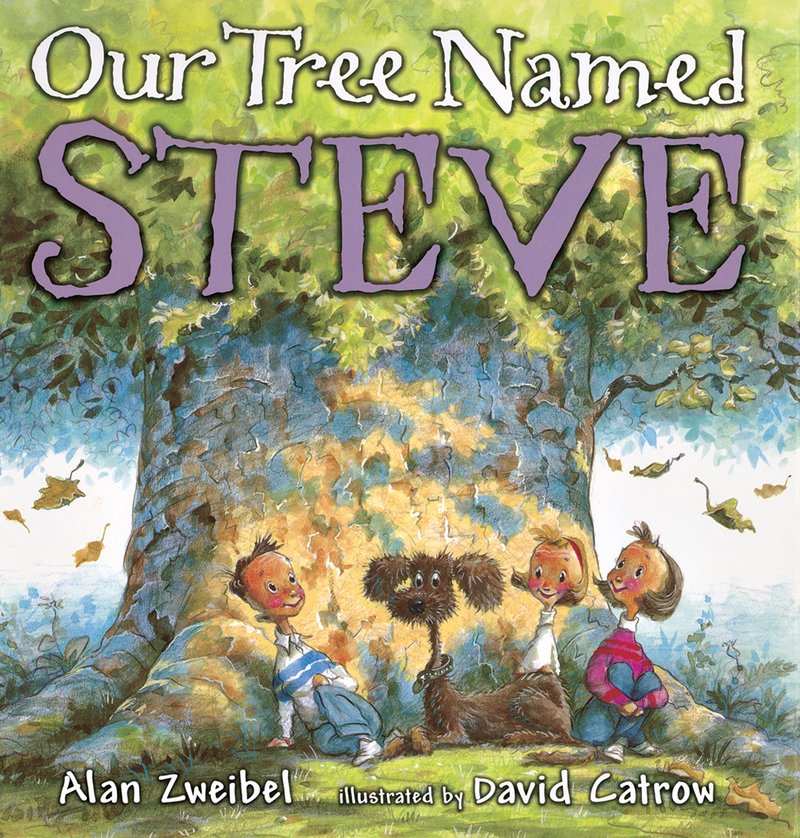
Dear Kids, A long time ago, when you were little, Mom and I took you to where we wanted to build a house. . . . I remember there was one tree, however, that the three of you couldn’t stop staring at. . . .

After the family spares him from the builders, Steve the tree quickly works his way into their lives. He holds their underwear when the dryer breaks down, he’s there when Adam and Lindsay get their first crushes, and he’s the centerpiece at their outdoor family parties. With a surprising lack of anthropomorphizing, this is a uniquely poignant celebration of fatherhood, families, love, and change.

Our Tree Named Steve has to be a true story. It feels like one. I read the whole thing, standing up, in the public library where I saw it (it was standing up, too) on top of a book case in the children’s section. It almost made me cry. In the library.

The Art of Memory

David Catrow’s wonderful illustrations are as good as the text and embrace the sound and sense of it completely. I especially loved the children’s faces. Something about them reminds me of the way we looked, my siblings and I, in childhood. The illustrations are as fanciful as they are realistic, but it’s a familiar, friendly-dog-chicken-casserole kind of fanciful, not surreal or exotic. It’s the reality of memory – loving, a little goofy, depicting the feeling associated with an event more than its historical fact. This is what makes the characters and places recognizable, although we’ve never met them.

For the Parent

Our Tree Named Steve is written as a letter from a father to his children, and as it progresses, you realize the children are grown up, or nearly so. It’s what makes the story tug on your heart-strings as an adult reader. You recognize both perspectives in yourself – the father helping his children confront a loss and the children saying goodbye to a part of their childhood. I’d question whether the book is more for adults than children, except that children will easily relate to the humorous, comfortable voice of it and the everyday events it recounts. Some of the best children’s books reach the parent over the child’s head. It’s a children’s book with an adult book hidden inside it.

Resurrection

Our Tree Named Steve is a perspective on grieving and on finding resurrection in the midst of loss. Without spoiling the book, which builds to a surprising climax and resolution, I can say it’s unusual for the grief book genre. It’s one degree removed from the usual plot and character roles, and this could be helpful. One part of me never wants a children’s story to be sad. We all want childhood to be happy, and we instinctively resist confronting our children with sorrow. But life happens, tears happen, and I think this book would be effective for some children simply because it is not about a pet or grandparent. If your dog has just crossed the rainbow bridge, you may not want to read a story explicitly about a dog crossing the rainbow bridge. Some children need a story that matches their own. Some children need creative indirection to process serious grief.

Piggy Parallels

This book reminded me obliquely of my own upcoming board book, Piggy in Heaven. Both books center as much on the experience of the “person” we’ve lost as they do on the mourners. And both explore the comforting fact that although it changes form or place, life goes on.

Our Tree Named Steve is available on Amazon in paperback and library binding editions.

Grandmother Reflections: 70 Years with Picture Books

Today, I’m interviewing someone I love. Kathy is a retired educator, mother of four children, and grandmother of 11 grandchildren. She has read picture books, used them at work, and created some for her family. Today she’s sharing perspectives she’s gained from more than 70 years of picture-book reading!

Melinda: What is the first picture book you remember reading as a child?

Kathy: I remember having The Little Engine That Could read to me when I was very young.  In fact, it became a family rule of sorts.  None of us where allowed to say that we couldn’t do something.  We all had to say, “I think I can.  I think I can.  I think I can.”

Melinda: What was your favorite part of reading books with your children when they were small?

Kathy: I loved settling on the couch or bed with little people cuddled on each side and on my lap as we shared a fun adventure together.  Sharing a book with a little one is such a loving thing, and it expands their world beyond just home and neighborhood as well.  I especially enjoyed sharing with them the picture books I had loved as a child.

I also loved the way that books can teach life lessons by stories without being preachy.  It reminds me of how Jesus taught by parables.  He made us, and He knows humans relate to stories.  Also the stories are about someone else and not pointed at us, so it is easier to not be defensive and just learn from them.

Melinda: When you began sharing picture books with your grandchildren, how had they changed from the books you remember reading to your children?

Kathy: That is a hard question. There are certainly many more stories available.  I think there is more diversity now, in a positive way. And the production of books now is advanced, so some of the pictures are more sophisticated and nuanced, and less cartoony or simple.  On the other hand, some illustrators now do simple drawings to reach out to children, and those are great.

Melinda: What are some books that both your children and your grandchildren enjoyed? Why do you think they worked so well for both generations?

Kathy: I actually read some books that have worked for three generations – my childhood, my children’s childhood, and now my grandchildren’s.  I think there are some universal human experiences that resonate through the ages. An example, to return to The Little Engine That Could, is the experience of not having the resources many have and yet keeping a positive attitude and making the best of what you have.  This kind of approach is admired and appreciated by others, and it comes across in the story without being preachy.

Melinda: How did you use picture books as an educator?

Kathy: Many educators try to relate different subject matter to make a more connected whole of a concept.  When I wrote elementary math curriculum, we used picture books to get across ideas in an appealing way and to illustrate without making a point of it that math is part of everyday life.  For just one example, there is a wonderful picture book called The Doorbell Rang that worked very well for teaching fractions and, incidentally, sharing as well.

Melinda: How can authors and publishers make a picture book especially effective for classroom use?

Kathy: This is tricky. Many authors have tried this, and few really succeed.  I think many books like this are too conscious of trying to teach rather than just sharing a good story that can then be applied to a concept in some school subject.  I guess I would say to start with a good story you are excited about, and if it is true to life in reality or imagination, then it might easily be applicable in a subject.  For example, if you love quilting, write a  story about quilts.  There are actually already a number of good quilt stories that can be used to teach history about the Civil War and Underground Railroad, or about geometric shapes and repeating patterns.

Melinda: What is the funniest picture book you remember reading?

Kathy: I always loved Amelia Bedelia stories.  If you have never read one, give yourself a treat and find one at the library.  Amelia is a literalist who misinterprets the meaning of words because of the way they are used colloquially.  I chuckled all the way through each of them.  Words are such fun – used or misused, they are still fun.  Some of the funniest things I remember as a teacher were mistakes students made from misusing words – for example, the youngster who wrote about how effective “gorilla warfare” was.

Melinda: What is the most important picture book you’ve read? Why?

Kathy: How to choose?!  Well, we used many different Bible picture books with our children for evening worship each night, and these made the stories more real.  Since our daily life is not like it was in Bible times, something that helps us understand the meaning is really important.  Other than that, I think the story Beginning with Mrs. McBee by Cecil B. Maiden is outstanding as it demonstrates with humor and humanity the concept of passing good on rather than paying it back.  I have read this with our children and grandchildren and still love it regardless of how often I read it.

The Runaway Bunny as Christian Allegory

In this remarkable scene from Wit (2001, directed by Mike Nichols), Evelyn Ashford (Eileen Atkins) comforts her dying friend and former student Vivian (Emma Thompson) by cradling her gently and reading Margaret Wise Brown’s The Runaway Bunny.

At the 5:00 minute mark, these two grieving women, both academics, share a surprising discovery about the book. “Ah! Look at that,” Evelyn says smiling. “A little allegory of the soul. Wherever it hides, God will find it.” Vivian is hardly able to speak, but the moment figures as a turning point as her suffering gradually gives way to sleep.

The Runaway Bunny is a picture book classic, most often read in the same spirit as books such as Love You Forever or Guess How Much I Love You. It’s meant to be read over and over again, until the words are all memorized and the spine cracks and the pages fall out. Little ones never tire of hearing that wherever they go, however life changes them, their mama will find them and bring them home.

It’s a logical choice for the film, which chronicles the inward journey of an intellect-centered college professor struggling for transcendence as she dies of cancer. Her friend and mentor in this scene is much like the mother bunny in the book. Evelyn arrives at the hospital having only just learned that Vivian is there. What are the odds? It is a detail just touched on as Evelyn takes off her coat, but it is the same quiet miracle as the mother bunny finding her baby wherever she goes. The little bunny who keeps trying to shape-shift, to become some other animal, to have some other life, mirrors the human journey to discover and improve our actual self, the one we hope to keep. And the kindly, humorous, unfailing persistence of the mother bunny is the Love that birthed us and leads us home.

Of course, once you begin to hold a lens over the story, you see more in it than you first expected. Consider the progression of transformations the little bunny suggests, and the ways his mother answers them. These pairs of images are rife with Christian symbolism!

I will be a fish in a trout stream/ I will be a fisherman. Jesus calls His apostles with the promise that they will become “fishers of men,” gathering in new believers.

I will be a rock on a mountain/I will be a mountain climber. He calls Peter the “rock” on which He will build the Christian church.

I will be a crocus in a hidden garden/I will be a gardener. When Mary comes to  the grave seeking Jesus after his crucifixion and He meets her there, she believes at first that He is the gardener.

I will be a bird/I will be the tree you come home to. The tree is a reference to the Cross, the place to which Christians “fly home” in search of eternal life.

I will be a sailboat/I will be the wind.   The wind is the Holy Spirit, and “blows where it will”, just as the mother bunny will blow her little sailboat “where I want you to go.”

I will be a trapeze artist/I will be a tightrope walker. The circus is an old and often-used metaphor for the world (as distinguished from heaven or the Church). Biblical tradition describes Satan as the “lord of the air,” and Jesus harrowing hell and rising to heaven “clears the air,” overcoming what darkness lingers there. Thus, like the mother rabbit, He meets us in danger and saves us. Alternately, the trapeze artist and the tightrope walker could prefigure the Second Coming, when believers will be “caught up together in the clouds” and “meet the Lord in the air.”

I will be a little boy/I will be your mother. This pair brings the little bunny to the pinnacle of Christian imagery, and teaching – the incarnation. Interestingly, in this final iteration, the little bunny has assumed the divine role (the Son of Man, born on earth) and the mother bunny plays the dual role of birthgiver and guide. She will be this little boy’s mother and catch him up in her arms to hug, just as Mary must so often have embraced Jesus in her role as Theotokos, God-bearer, mother. But simultaneously, this is also the role in which she succeeds in bringing her little bunny home to his true identity, a nod at the salvific power of the incarnation and the Christian striving to be in God’s image. When the little bunny chooses an identity that both parallels and transcends his present life, he has come to the end (or beginning!) of his spiritual journey. And of course, he has found his way home.

The Runaway Bunny by Margaret Wise Brown, illustrated by Clement Hurd, was first published in 1942, and is still in print!

Guest Post: Teaching from a Love of Language

Guest poster Melissa Naasko shares this fascinating look at the way she’s teaching reading, writing, and a life-long love of good literature as she homeschools her 11 children.

I love words. I love the way that carefully chosen words capture scenes that are burned into my mind for years like tin-type photos, the way that they can draw up emotions from deep within like a bucket dropped into a well, and the way they melt onto my tongue and shape my own words as I quote them. I pore over phrases and specific word choices as I read books and articles and poetry. Simply put, I love words and I want my children to love them as much as I do. This means I want to cultivate a love of delicious, gourmet words in my children, so I work very hard to set before them a steady diet of quality literature. I cannot abide cheap, empty words, which means that I am exceedingly particular about the books I give my children.

How I Teach Writing

I teach my children how to write using quality children’s literature. I focus on books that use well crafted, memorable language, or sometimes words that are simple and pure but surprisingly evocative.

Children who are in the upper elementary and middle school grades use language of about the same sophistication. Using these books means that they can see how words cooperate with each other in different kinds of literary techniques, and they can imitate them for their own pieces.

Our Writing Workshop

Every month, we take a full day to have a writer’s workshop, and we push aside all other schoolwork and even most of the housework. I pick a theme, sometimes in cooperation with the teenagers who have their own favorite books and themes and techniques. I read aloud the books within the theme and focus on the words and the way that they play, and the children are not allowed to look at the pictures, which can sometimes be a distraction when we are specifically focusing on language. Sometimes we talk about the art, but that is a separate discussion, and while there is some overlap in my favorite books for words and my favorite books for art, there are pretty distinct books in both categories.

Sometimes, our theme is memorable language, phrases we can’t forget and find ourselves using again and again. Sometimes, it is realistic dialogue, wherein the words spoken by the characters flesh them out and give them depth. Sometimes, our theme is books that make us cry. Sometimes, it is books that make us ecstatic. Occasionally, it is the whole category of books that just make us feel anything intensely. One of the children specifically likes books that help her develop her sense of pacing because she likes to write suspenseful stories and tease out just enough information to keep her readers on the edge of their seat without frustrating them to the point that they leave.

Two Resources

I started teaching with this method after reading Teaching Writing with Picture Books as Models. This amazing book gave me a starting point for the conversations I have with my children. Since then, we have expanded from the book and its suggestions, but it was invaluable in the beginning.

I also suggest that you give your children a chance to write for an audience. My children are in love with a platform called StoryBird. This website allows children to create profiles from which they write stories. One of the best things about this site is that it doesn’t allow children to use real names or create profiles that reveal contact information or can be contacted privately. All comments on stories are public, and both the stories and the comments are reviewed and culled as appropriate. Accounts are free, but it can take a couple of weeks for a story to move through the moderation process, and this is sped up if the child has an account, which is pricey at $60/year. As a parent, you can create a free space for your children to write for assignments which is moderated and reviewed by you. The same can be done by traditional classroom teachers, but these stories cannot be viewed outside of the class.

Favorite Books

There are loads and loads of wonderful books that work for this teaching method. I thought I would tell you about eleven different books, each of which is a favorite of one my children or myself.

Wilfrid Gordon McDonald Partridge by Mem Fox

This evocative book never fails to make me cry. I have to read it slowly and breathe deeply because I cannot suppress the tears. It is about a little boy with four names who is friendly with the elderly residents home next door. He helps them remember things that they have forgotten. The language is simple and uncluttered but profoundly moving. When the author discusses an elderly woman who remembers her brother who went to war but did not come home it is what is not said that tightens my throat and makes my eyes well with tears. Simply writing about this book bring me to tears.

Rabbit’s Search for a Little House by Mary Deball Kwitz

This book uses simple, repetitive language to tell the story of a mother rabbit looking for a home for herself and her little rabbit as winter approaches. In our family, it is tradition to read it aloud with tea or hot chocolate and some home-baked treats on the day of the very first snow of the year. Our well-worn copy is very lovingly cared for by our children, and it holds pride of place in the house. We started this tradition with our oldest child, and now it is ingrained in the memory of our youngest as a pivotal celebration in the changing of seasons. My children recite lines from this all winter long.

The Relatives Came by Cynthia Rylant

This book beautifully captures the emotions of having a large, extended family coming to visit by touching on the physical aspects of it all. The author focuses on things like the sound of a house full of sleeping people breathing and being pressed in together in beds and on floors in makeshift sleep mats. The sensory aspect of this book is incredible. We had dear friends travel with their seven children to visit us, and many lines of this book were recited by my children describing having nine more people squeeze into our little farmhouse. It is a cozy, comfortable book worth reading again and again.

A Chair for My Mother by Vera B. Williams

Sometimes, books make all families well off and comfortable with few-to-no wants. This book captures what it is like for other families. I grew up very poor, and while my mother worked very hard to give us all us a sense that we were lacking nothing for being wrapped in love, I noticed other children had more than us. This book reminds me of my childhood. Following a tragedy, this little family of a daughter, a mother, and a grandmother find that they lose everything they own, and all they want is a chair. The language is gentle and not heavy handed, but leads the child to compassion in a subtle way.

All the Places to Love by Patricia MacLachlan

This is another book that always makes me cry. One of my children loves this book especially, and it probably started because a character shares his name. We live on my husband’s family’s nineteenth-century homestead, and there are many places here that are loved by different family members who are happy to tell my children about how they used to hide in the flour bin, the hoosier cupboard, or their favorite fishing spot at the creek. This book follows a family by discussing how their farm speaks to them. MacLachlan is a master of fleshing out characters in ways that are so delicate they are almost indiscernible, yet there they are.

Selma by Jutta Bauer

This book is very simply written, and it touches on what is the nature of happiness and the meaning of life, in discussing a little ewe. We raise sheep, so anything involving sheep interests my children, but this book touches on the beauty of a simple life. One time, we were in a group and the children started talking about what they would do if they had a million dollars and all the things they would buy. My son said all he needed was a little grass, a little lunch, a gossip with the neighbor, and he would be happy. This is the book I pull out when the little people are feeling a little greedy because it reminds us that we have all we really need.

The Memory Coat by Elvira Woodruff

My husband’s family immigrated from Finland at the very close of the nineteenth century and established this farm under the Homestead Act. In the upstairs hallway is the original deed signed by Teddy Roosevelt and copies of the Ellis Island manifest where they signed their names as they entered the country. I want our children to know what this meant, just what this process was. This book is an excellent way of showing it. The family in the book is entering the country and subjected to a brief physical exam, and it appears one of the children will be rejected and sent back home. Every time we read it, the children weep in fear for this child and sigh deeply in gratitude at the resolution. It is a book that they come back to when they talk about the needs of other children, and it is woven into their consciousness.

Roxaboxen by Alice McTerran

This book was chosen by one of the children but is a favorite of my husband in particular. He loves to read this book aloud to them. It is about a group of children who played town, like all children do. It is such a simple story, but it takes on a life of its own as our children think of the children as being like them and as we parents remember the children we used to be. When I teach the memoir thing, I ask the children to explain to me the way that they live their fantasies now. They don’t understand yet that these are the stories that shape the adults they will be and the ones that they will come back to when they need to know who they are.

The Old Woman Who Named Things by Cynthia Rylant

This book was chosen by one of the youngest children and by one of the oldest whom I then asked to name another book. This book uses self-conscious personification to develop the main character of the book, and it highlights her loneliness. Ultimately the book resolves well, but it is always a moving book for the children as they consider times they have been lonely. As they contemplate how they could have or would have alleviated the old woman’s loneliness, they stretch their little hearts and teach themselves how to love.

Blueberries for Sal by Robert McCloskey 

This is a classic book, a giant in the canon of children’s literature. The story of a little bear and a little child becoming separated from their mothers and instead following the other mother is a classic. The world is big and getting lost happens, but how we find our way home is what counts. One of the things that my children like about this book is how the cub and child are similar, as are the mothers. The child who chose this book told me that it is fun to think of how we can be so different and so alike, and I think that is how we find our ways home.

The Hundred Dresses by Eleanor Estes

This is a book that I buy for every little girl we know at some point in her childhood. I have spent a lot of money sharing this book over the years. This book is about a clique of unkind girls, including one who is reluctantly mean, and the way they taunt another little girl. The subject of their cruelty is poor and wears the same dress every day, and when asked if she owns another, she tells them that she has a hundred dressed lined up in her closet. The resistance of the main character and her regret over actions inspires such kindness in children. If I could buy a copy for every child in the world, I would. That said, despite the fact that little girls are more likely (in my experience) to happily read a book about dresses, this theme is important for boys, too. My boys have all read and enjoyed this book.

What books would you include in your list and why?

Melissa_Naasko_280

Melissa Naasko is the wife of an Orthodox deacon, the mother of eleven hungry children, and author of Fasting as a Family from Ancient Faith Publishing. She cooks, knits, and writes from the Upper Peninsula.

This post’s first photo is by Milan Popovic on Unsplash. Melissa and I chose it because we think it captures childhood.

First picture book you remember?

I love to hear quirky, detailed, real-life stories from people I know. I’ll ask a question about some little thing that doesn’t come up in an ordinary day. The answers are endlessly interesting – a person’s memories, and the ways they recount them, are full of clues about how they see the world and themselves. It’s a chance to stand in their shoes for a moment, catching a glimpse of what you’d see looking out on the world from their eyes.

The Question

Today, I asked, “What is the first picture book you remember, either reading yourself or having read to you, and what do you remember about it?” Here’s what my friends said!

The Answers

This survey was conducted on Facebook. Responses are copied exactly, with the exception of some minor typo fixes.

Todd: Corduroy.”

Selena:The Rabbits’ Wedding by Garth Williams.”

Ashley:Pat the Bunny….I remember patting Daddy’s beard in the book and then feeling my own father’s face. I loved how the world in the book matched my own little world at home.”

Richard:A Ghost Named Fred by Nathaniel Benchley. George playing astronaut.” (Thanks, Richard, for the photo of George playing astronaut. That looks like the original copy of the book – a little battered, but still read!)

Nitsa: “A Greek book about Popi and Eleni and a dog. No idea what it was called. I remember the simple drawings of the girls in their dresses and of the dog. Nothing fancy. I also remember that Greek dogs say ‘yav yav’, not ‘woof woof’!”

Katherine:The Little House by Virginia Lee Burton. I was a city kid who longed for the country, and I so identified with that little house.”

Kelleylynn: “I wasn’t read to as a small child, not by my parents (please don’t feel sorry for me) but in second grade, I vividly remember my reading teacher, Mrs. Lattner (yes, the mother to pro basketball player) would read a daily poem from Shell Silverstein; most especially The Giving Tree. So I gave (back) like the Tree to my children.
I’ve grown a grand love for good children’s literature and read daily to our children, especially instilling the love for the zany and quirky authors such as Roald Dahl and Charles Dickens; fantasy and poetry.”

Marie: “This was not long after WW2. It was a Danish book a friend had sent to thank my mother for all the material help she had sent – mostly food and clothing – to her and her neighbors in the immediate post-war period. It was about a little boy named “Peter” and I looked at the pictures while my mother read the little story from a handwritten translation into English.”

Barnabas: “Learning to read using the Dick and Jane books.”

Joanne: “Ditto, this (Dick and Jane) is what I remember, too.”

Joanna: “Not the first, but one that stuck with me was Little Bear’s Trousers. The illustrations were incredibly detailed and I would read it over and over just to have an excuse to look at the pictures and admire all the different textures. There was a cake at the end that I always wanted to eat because it looked so delicious. I lost my copy as a kid and was always sad to have it gone. After telling my husband about it when we were first married, it showed up in the mail one day as a surprise. I got to read it again to my step kids and now to Ruth.”

Tanya:Go Dog Go. I remember the dogs.”

Tammie: “Cappy. Its about a dog who gets in trouble. 😂 Not the first book but definitely a memorable one because it was the first one I had planned to buy with money earned from working for my dad. It was a ‘first purchase alone w/o parents’ kind of thing. I walked home from the bookstore a happy kid!”

Kathleen: “This will come as no surprise to you, Melinda: a joke book with pictures!”

Audra: “I remember my mom reading me a book about a snowshoe hare afraid to change colors with the seasons.”

Elizabeth:Peter Rabbit by Beatrix Potter, which is curious, because I also remember not liking anthropomorphic animal stories in general. I also remember The Little Engine that Could. I was so happy for the Little Engine that he made it. I actually remember a lot of stories. We had books upon books in my house. Being read to and learning to read are among my cherished childhood memories.”

Michelle:I learned to read with Go Dog Go.”

Bonnie:Caps for Sale was one. Where the Wild Things Are, and The Monster at the End of the Book (Sesame Street, my mom did a great Grover voice!). And for remembering – for Caps, it was hilarious the amount of hats, for the Wild Things the illustrations, and for The Monster at the End of the Book, it was interactive and of course my mom’s Grover voice. I have the book and do the voice now with my kids.”

Christine: “Mike Mulligan and His Steam Shovel.” [Here’s my post about Mike!]

Svetlana: “I remember reading the Cajun Alphabet book. A is for Alligator and B is for Baton Rouge. I was four. The other book I remember from when I was really young was The Little Mermaid. It was not a childish fairy tale. The pictures were really beautiful watercolors. When she walked it was like stepping on knives. When she danced, she forgot about the knives. When the Prince too another woman to be his wife, her sisters gave her a knife from the Sea Witch to kill him. They had all sold her there hair for the knife. His death would allow the Little Mermaid to return to the sea. Instead she walked out in to the sun and became sea spray. That one was also before kindergarten. I have no idea who wrote it, but I’ve never seen a Little Mermaid like it since.”

Andrea:I Know a Farm. The memorable thing about that was it came in the mail, as a book club selection. I seriously doubt this was the first book read to me, but it is the first I remember receiving.”

Edith:The Cat in the Hat.”

Tawni: “I know Poky Little Puppy, Saggy Baggy Elephant, and Tawny Scrawny Lion were among my first favorites. And now I read them to my kids!”

Peggy:A Fish Out of Water, a Dr. Seuss book, I remember being so worried about that fish as the little boy gave him too much food and Otto grew bigger and bigger.”

Elissa: “I remember the Little Golden Books, especially Hop on Pop and Take Me To The Zoo.”

Jonathan: “The Poky Little Puppy.”

Elina: “The Serendipity books. I remember the fanciful illustrations and the characters – how they made me feel – like there was a beautiful world out there that I knew nothing about. I loved them, and stumbled across the collection a few years back and am so happy my kids are reading them now!”

How about you?

What is the first picture book you remember? What do you remember about it? Why did it matter to you?

It’s fascinating to consider how many books have touched us at one time or another. Some were good, some we hated. They all leave a mark, don’t they?

The Happy Man and His Dump Truck, by Miryam

“A happy man thrills a group of farm animals when he takes them for a joy ride in his dump truck. This book is a true classic illustrated by the inimitable Tibor Gergely.”

The Happy Man and His Dump Truck is one of my favorite picture books. The first time you read it, you think it’s a simple, funny little story. The second time, the third time, you realize how much depth is shining inside that apparent simplicity.

Here’s the story. A happy man is driving down the road in his dump truck. He meets some farm animals who want to go for a ride in his dump truck. So he takes them for a ride. They like it so much they ask him to take their friends for a ride. He comes back and takes even more farm animals for a ride. Then they say goodbye, and he drives away, just a happy man with a dump truck.

But there’s so much more to the story!

Happiness and Kindness

The best lessons in picture books are the ones you don’t realize you are learning. When you read this story, it seems completely natural that the happy man, and the happy animals, would want to share the fun. Real happiness is generous. Little ones hearing this story are still at the age where they won’t share toys and treats without prompting (sometimes lots of prompting!). But they are also capable of deep love and sudden generosity. The story is a funny, age-appropriate example of sharing that went well for both parties, the giver and the receiver. We are all growing into the kind of people whose first impulse is to share the best of what we have, always.

Simple Life

I love this book for its innocent, agrarian setting. I love it for its total absence of modernity. The only technology in the book is an old-fashioned dump truck driven by a man who isn’t being tracked by GPS and therefore can stop along the road to play with farm animals. The more screens, wires, waves, beeps, and clicks surround our children, the more they need stories that reconnect them with the simple outside world. Our children need farm animals and dirt, green grass and free time. They need to remember what sound a chicken makes. They need to develop an imagination that immediately grasps what a great slide you could make in the bed of a friendly dump-truck.

Spontaneous, Not Random

The happy man is not the only example of generosity in this book, or kindness. The animals are generous, too. Not all of the farm animals are present when the happy man first drives by. He gives several rides because each group of animals asks him to come back to the farm and pick up the next group. So all the characters in the book are responding to a gift by passing it on.

We hear a lot about “random acts of kindness,” and I am thankful for their influence in the world. But I prefer to describe kindness as “spontaneous.” Kindness is not random. Kindness is the natural expression of goodness that comes from the heart. It can inspire us at any moment, in any situation, and because we often don’t foresee that inspiration, it is spontaneous. The cycle of generosity in this book is a wonderful model for children, and adults. When something good happens, what is our first response? When we receive gifts, or are blessed with good circumstances, we need to think like the happy man and his animal friends. “I love this. How can I share it?”

This Classic Little Golden Book is available on Amazon in a hardcover edition.